Income Statement
We looked at the Disney cash flows from 1983 to 2000. Disney Net Income grew over the 17 years that Eisner was CEO and here’s what it looks like on the graph below.
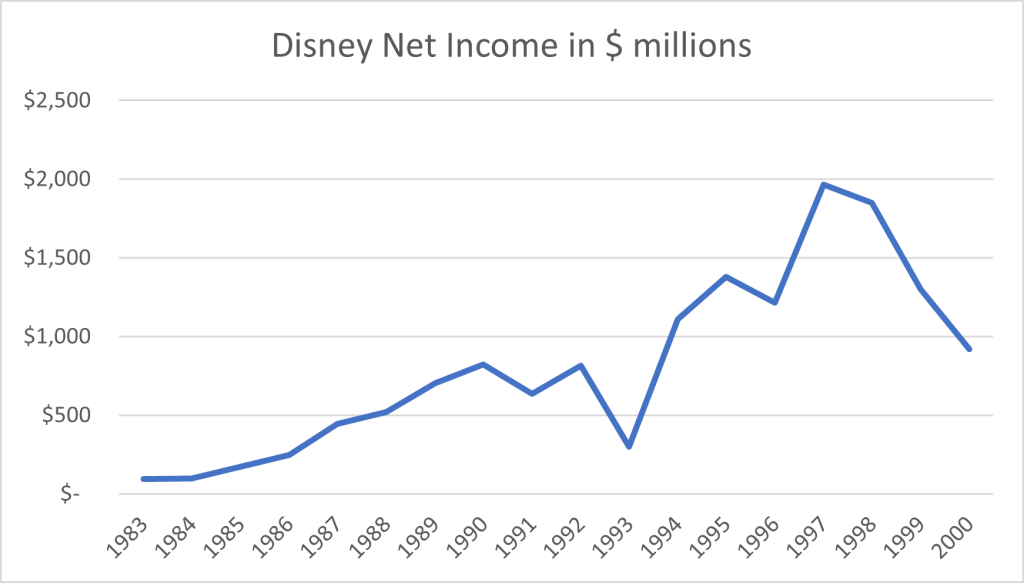
In 1993 Disney bottom line was suffering due to high expenses in Theme parks and resorts, Studio Entertainment and Consumer Products. In regards the Theme parks, Disney has lost $1 billion back in 1992 and was still feeling the effects in 1993 and had expense of $747 million in 1993. Disney also acquired Miramax in 1993. Disney typically produce 18 films per year but in 1993 had ambitiously created 68 new films and had incurred $622 million in Studio Entertainment expenses that year. In addition to acquiring Miramax, in 1992, Disney had consumer products issues. Disney spent $50 million to purchase the Anaheim Ducks. To cross-market, Disney spent 80% of the Ducks revenue on duck’s wear merchandise. The spending didn’t stop there, Disney dropped another $10 million on a theater production with Beauty and The Beast.
Disney went through turmoil in 1994 & 1995. In 1994 the Disney President Wells died in a helicopter accident in Nevada and his deaf created a void in the company. Katzenberg tried to step in and fill Wells’ place and was rejected for the position and shortly after left the company. Also, in the same year, Eisner at the age of 52 had quadruple bypass heart surgery and this was another setback for Disney. In 2000, Disney had higher than normal expenses in the Theme parks and resorts and Media Networks. Disney was adding Theme Parks to their existing Theme Parks, thinking if they added three theme parks in one, people would stay about 3 days longer. This theory didn’t work, and people only stayed about 1 day on average. Disney also had a major push in the Media Networks. Disney started selling online products but failed at a subscription-based service called the Daily Blast. Disney also merged its Internet assets with the search engine Infoseek. This included Disney.com, ESPN.com and ABCNews.com and a portal called www.go.com. Go.com lagged in comparison to its rivals. In 2000, Go.com laid off 20% of its employs and started focusing on e-commerce. Because of these setbacks, Eisner said Disney needed to cut back operations. Disney started cost-cutting and was projecting to save $500 million per year going forward in 2001.
Net Profit Percent
TheNet Profit Percent shows the after-tax profits to net sales. It shows the remaining profit after production, administration, and financing. Disney experienced a low Net Profit Percentage of 11% in 1984 and a high Net Profit Percentage of 25% in 1987.
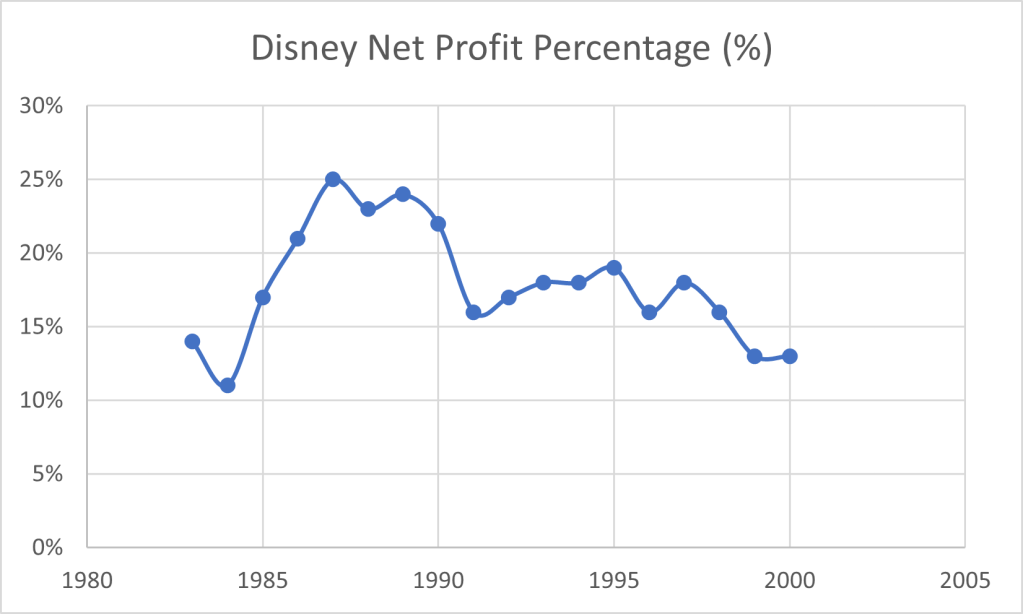
In 1984 Disney hired Michael Eisner and Frank Wells. In that same year Disney also created Touchstone and entered into the movie industry targeting adults. They also acquired the Arvida Corp, a Real estate development company to help them develop their Theme Parks. Despite Disney efforts, the Theme parks and resorts and Studio Entertainment revenue where down. Theme parks and resorts were at $1,097 million and film was at $245 million in revenue annually. In 1987 Disney opened its first Disney retail stores in the consumer Products area which gave Disney a $37 million boost in revenue from the previous year. Disney also purchased KCAL a Los Angeles based TV station which gave Disney additional film revenue of $364 million compared to the previous year.
Return on Equity
Return on Equity or ROE is a measure the financial performance. ROE is sometimes thought of as a return on net asset. ROE is calculated by dividing Net Income by Shareholders Equity. Disney had a 26% high ROE back in 1989 and a low of 4% in the beginning of 2000.

Back in 1989, Disney again had their Theme Parks and resorts bringing in the sales. The higher than normal Theme Parks revenue was coming from Disney above average ticket prices. Disneyland in Anaheim, California ticket prices where at $28 and Walt Disney World in Lake Buena Vista Florida was price at $33 while the other Theme Parkes was averaging around $20 per ticket. The lower-than-average ROE of 4% back in 2000 was due to high expenses in the Media Networks. Disney had high expenses when it came to ABC TV Networks, ABC Radio, ESPN, The Disney Channel, Toon Disney and SoapNet. These Media Networks were costly, and which lowered down Disney ROE to 4% the year.
Balance Sheet
Current Ratios
The current ratios compare the current assets to current liabilities to give potential creditors a measurement of the company’s liquidity and it’s calculated by dividing current assets by current liabilities.

In 1997 Disney had a 35% Current ratio, when a company has a high current ratio, it may indicate that the company is not efficiently using its assets. In the years before, Disney had just purchased an educational retreat, a Sports complex, and an indoor playpark. Also, in 1988, Disney purchased a cruise line in the Theme Parks category. However, the revenue in 1997 was only up $208 Million compared to the previous year and was not enough to support the expenses. The combination of the cost of these purchases and slow growth in Theme Park revenue pushed Disney Current Ratio to an all-time high of 35%.
Debt/Asset Ratio
The Debt to asset ratio tells the user of the Financial Statements if the companies’ assets are financed by equity or by debt. If the ratio is above .05% the company assets are financed by equity and if the ratio is lower than .05%, then the company assets are financed by debt.
From the illustration above, we see that Disney kept a debt to asset ratio above .05% from 1983 to 2000. Disney assets which were financed by equity means the money normally came from stock investors that poured money into the company because of the brand name and because of the Disney leadership and high-quality products.
Market Cap
The Market capitalization pertains to the total dollar in market value of Disney outstanding shares. This gives the financial users the current market price of one share. Disney Market Capitalization as of March 26, 2019, is $197.99 Billion.
CEO Recommendations
In terms of the Accounting Financial Statements, we would like to recommend the CEO raise the 10% collected on the international Theme Parks because this seems to be can area of contention but a good brand strategy. We also would recommend keeping the corporate locations consolidated in one central location for more cohesiveness within the organization and to manage in the same way that Eisner did. The growth strategy was smart and the 20% is still attainable with creative investing.
 Lampkin Corporation, Inc.
Leave a comment